
The rise of sewage-related illness and environmental damage in the UK has led to an ever-growing swell of determination to protect Britain’s waterways, seas, and people from poo. Many things have contributed to growing public awareness and concern: campaigns from organisations like Surfers Against Sewage; television shows such as Channel 4’s Dirty Business; a whole county voting no confidence in private water company South West Water; and sewage pollution and prosecution (or lack thereof) repeatedly featuring as a hot topic in national news. But what are the solutions, and who is responsible for delivering them?
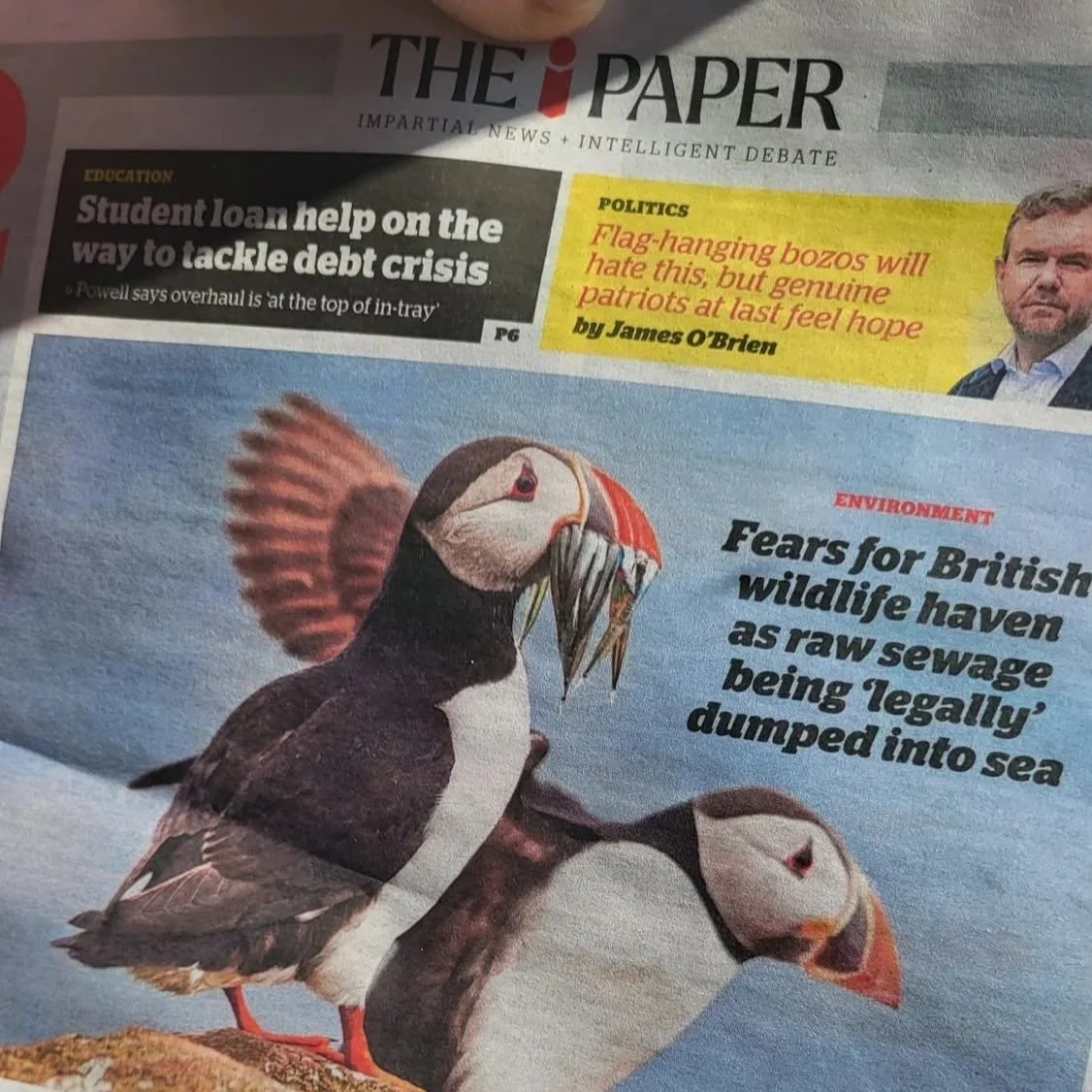
Front page of The i Paper on Wednesday 29th July, 2026.
What do we want? change! when do we want it? now…?
It’s easy to point fingers and call out the problems in our communities and country, but what can be done to improve outcomes for people and our environment?
First there must be an awareness of where and how things went wrong. Nobody highlights the #dirtybusiness of sewage pollution for fun. People are genuinely concerned for the health of their families, and the present and future health of the environment and its wildlife. We know that what we put in our water ends up in our bodies and this is only going to increase as the UK heads toward greater reliance on desalination plants for drinking water due to climate change. Sewage pollution is dangerous, but what can we do about it?
After awareness, there must be a motivation to act. Knowing that there is a problem - a very real problem - is not enough to bring about change. We must do something if we want to change the outcome for the better, and we must do it with integrity. Whether we act as an individual, a community, a business, a charity, the media, as local or central government, or even if we do nothing at all, we have a role and a place in the future we’ll find ourselves in. That’s why we need a viable plan.
What do we want? change! what does it look like? How?
If asked whether raw sewage should be pumped in to the sea close to shore on Scilly, most people will object: it may harm children and families, Grey Seals, Humpback Whales, Reefs, and many more species, as well as affecting tourism. If you then proposed to pump it much farther off shore instead, perhaps a few less people will object despite it still being illegal here. But what if you were to propose a legal but dirty, ugly, smelly sewage treatment plant on an otherwise beautiful island beside homes, beaches and SSSIs, and holiday lets within the Isles of Scilly National Landscape, a jewel in the crown of the UK, which is heavily dependent on tourism? What might people feel then? You could find that people shift towards finding sewage pollution to be far more reasonable when it’s out of sight, out of mind, and back in the ocean, because then it won’t be in their backyard. Anyone could be forgiven for not wanting a wastewater treatment works like that nextdoor.
Will this be the type of community-dividing revised proposal a company like South West Water might offer Scilly? A cheaper, unimaginative and oversized, smelly conventional secondary sewage plant that fails to provide enhanced tertiary treatment like UV disinfection? It might be presented as causing more problems than it solves, with sewage sludge waste that needs to be shipped off island for processing, instead of utilised for the benefit of the islands. Will increased energy requirements be argued as unreasonable, making it logistically, environmentally and/or economically unviable to deliver? People may understandably object to intentionally poorly marketed solutions, but these are far from the only options avaialble.
In this and future updates we’ll introduce case studies and possible alternatives to the type of wastewater treatment works and sludge processing that people usually object to. It is possible to protect the environment and residents, and to do so without harming tourism and island life on land. There can even be benefits for small communities. Innovation has led to successes for other companies around the UK and Ireland, but will SWW get creative with their solutions too?
big objections lead to beTTer practice: two case studies
Arklow, Ireland
After many years of raw sewage discharge into the Avoca River from 13,500 people and 30 years of delays and objections about how to address this, an innovative yet conventional sewage treatment facility was built in Arklow, Ireland. The site is fully enclosed in architect-designed buildings which house the conventional sewage treatment systems, only they do not smell and increased, instead of decreased, the value of the surrounding area, as the site finally allowed for economic progress. Rather than digging deep, exposed tanks, the works were built upwards and indoors. Arklow is an example of what can be achieved with innovation and determination to provide the best possible solution for an area, even when using old technology.
This Irish site is capable of expanding its treatment to a population equivalent of 36,000 so it’s significantly larger than Scilly could ever want or need, and sited within buildings that St Mary’s would never house. Whether it’s scalable to suit Scilly or not, Arklow is a testament to what collaboration and creativity can achieve when there’s ample desire for the best outcome.
Porlock, Somerset
Closer to home and with a much more realistic population equivalent (P.E.) and footprint, there is Porlock wastewater treatment works, built within Exmoor National Park. It presently serves a P.E. of approximately 4000, similar to that of St Mary’s P.E., and utilises Membrane Bioreactor Technology (MBR). The site looks much like a set of standard agricultural buildings and has a small footprint. When built, it was the first site in Europe to use this technology. MBR allows for increased, discreet secondary and tertiary sewage treatment on a significantly reduced amount of land, which can be delivered inside negative air pressure buildings to prevent odour in the surrounding area. This technology also produces less sludge and can generate clean enough water for it to be reused for agricultural purposes, which would be of substantial benefit to somewhere like Scilly with our limited water supply. The technology is more energy intensive and costly, however there are green energy solutions that can be utilised to offset consumption. MBR is widely considered as one of the best technologies generally, and especially for remote and sensitive areas with limited space.
Get it right from the the start
30 years of fighting for the best solution is a substantial commitment; nobody wants decades more sewage pollution on Scilly. We very much hope that South West Water, the Council of the Isles of Scilly, and the Duchy of Cornwall will work together to deliver an innovative Scilly-specific solution from the start, rather than much later: we call on them to propose something befitting of Scilly’s beauty, that does not undermine the national and international importance of the islands’ environment and wildlife, and is equally beneficial for our terrestrial spaces, islanders and visitors. To prevent lengthy challenges, organisations should ensure that the Isles of Scilly become an example of best practice, rather than a cautionary tale for the rest of the nation. We hope they will also consider that the multi-site infrastructure that already exists at Old Town, Morning Point and Telegraph, may best suit a modern multi-site solution using modular MBR technology, to prevent most of St Mary’s becoming a construction site.
What comes next?
75% of land on the Isles of Scilly is owned by the Duchy of Cornwall. The Duchy will need to agree any improved proposals for wastewater treatment solutions being established on their land. Could they also be lobbied to financially contribute? Before his coronation, His Royal Highness King Charles became the first ever patron of Surfers Against Sewage, after all. Central Government investment may not be out of the question either, and is less of a stretch for the imagination since 60+ Parish Councils and Cornwall County Council recently motioned a vote of no confidence in South West Water. Following the appointment of a Prime Minister that advocates for public ownership of problematic utility companies, the eyes of the nation are likely to be on Downing Street, the South West, and in particular on Scilly, in the coming months and years. However, even without any additional investment, SWW have their significant allocated budgets for 2020 to 2025 as well as from 2025 to 2030 for Scilly left to spend, because they have not completed their WINEP AMP7 or AMP8 deliverables.
In addition to Duchy permission, South West Water will need to obtain an Environmental Permit from the Environment Agency (EA) and a license from the Marine Management Organisation (MMO) to construct and operate proposed works, as well as making a full planning application to the Council of the Isles of Scilly (CIOS) for any work that is not considered permitted development. Proposed works need to be constructed and in operation by September 2027 when the Local Enforcement Position ends.
We believe that it is perfectly possible, and indeed entirely necessary, to deliver the highest standards of sewage treatment for the Isles of Scilly. There is no reason for any proposal to be detrimental to either the environment or to island life on land. In 2026 there is ample technology and plenty of examples of bespoke solutions to reassure anyone with concerns. In addition, the EU recently adopted even stricter water regulations to address medications, chemicals, pesticides and other toxins in water by the utilisation of quaternary treatment. With new leadership in UK Government, will Britain follow suit? Scilly must become future proof through these upgrades; history cannot repeat itself and prevent Scilly from having legal, safe water and wastewater treatment when compared with our mainland counterparts.
These islands are amongst the most environmentally protected locations in the UK, so decisions made here regarding sewage pollution have far reaching implications for the rest of the UK. We anticipate that there will be substantial public interest throughout the process of designing and delivering any water and wastewater solutions for the islands. In addition, it is expected that there will be a full public consultation on the EA’s Environmental Permit decision, the MMO’s Licence application decision, and that residents and businesses will also share their views with CIOS both prior to and during any planning applications. Following the update from the Environment Agency, and national news coverage from the The BBC and The i Paper, there will be continued scrutiny and increasing public pressure on all involved agencies to ensure the delivery of the best possible solutions for Scilly.
